
How to get a Developmental Paediatrician appointment in Australia

A practical parent guide to referrals, waitlists, assessment pathways and what to do while you wait
Trying to get a developmental paediatrician appointment in Australia can involve long waiting lists, uncertainty about whether a referral has been accepted, and confusion about which assessment pathway your child actually needs.
If you already have a referral - or your GP has recommended developmental assessment - you may have more options than simply waiting. This guide explains how to navigate public and private pathways, what to check after a referral is sent, what other assessment or support may be possible while you wait, and what to do if your child's needs change.
Important: Developmental assessment pathways vary between states, services and individual children. A developmental paediatrician is not always the only clinician who can assess a developmental concern. Your GP and treating professionals can help determine which pathway is appropriate.
Already Have a Referral? Start Here
Before assuming you simply need to wait, work through these eight checks:
Confirm the referral was received.
Confirm whether the referral was accepted and whether any further information is required.
Ask about the expected waiting time and what happens next.
Ask whether the service keeps a cancellation list.
Discuss public and private referral pathways with your GP where appropriate.
If considering private care, contact more than one practice rather than assuming waitlists are the same.
Ask whether reports, questionnaires, hearing tests or other assessments are required before the appointment.
Return to your GP if your child's needs or functioning change while you are waiting.
What Is a Developmental Paediatrician?
A developmental paediatrician is a specialist doctor with a particular focus on child development, behaviour, learning and neurodevelopment. They may assess children with concerns involving more than one developmental area or where a broader medical and developmental picture needs to be considered.
Developmental paediatricians often work alongside psychologists, speech pathologists, occupational therapists, physiotherapists, educators and other health professionals. However, the right pathway depends on the child's individual concerns and the purpose of the assessment.
Do You Need a GP Referral?
A GP referral is commonly used to access developmental paediatric care in Australia. For private specialist appointments, a valid referral is generally needed for an eligible Medicare specialist rebate. Public developmental services also commonly have their own referral and intake requirements.
Practical question to ask your GP: "Can we explore both public and private options while we work out the most appropriate pathway?"
Related guide: Can Your GP Refer to Public AND Private Specialists at the Same Time?
Public or Private: Do You Have to Choose One?
Not necessarily. Depending on the services involved, families may be able to remain in a public referral pathway while also exploring private appointments. The two pathways can have different referral requirements, costs and waiting times, so confirm the arrangements with the relevant service rather than assuming one pathway automatically cancels the other.
Public services may be lower cost but can have lengthy or uncertain waits.
Private services may offer different availability, but out-of-pocket costs can be significant.
Different private practices can have very different waitlists.
Ask about cancellation lists if you can attend at short notice.
What Happens After the Referral Is Sent?
A developmental referral is not always followed immediately by an appointment date. The receiving service may first review the referral, decide whether it meets its intake criteria, and request more information before determining the next step.
You may be asked for information such as:
school or childcare reports
teacher or developmental questionnaires
previous medical or assessment reports
speech pathology, occupational therapy or psychology reports
hearing or vision results
information about how the concerns affect everyday functioning
Return requested forms promptly and keep copies of what you submit. If you have not heard from the service, it is reasonable to contact them to confirm the referral was received, whether it has been accepted, whether anything else is needed and what the next step is.
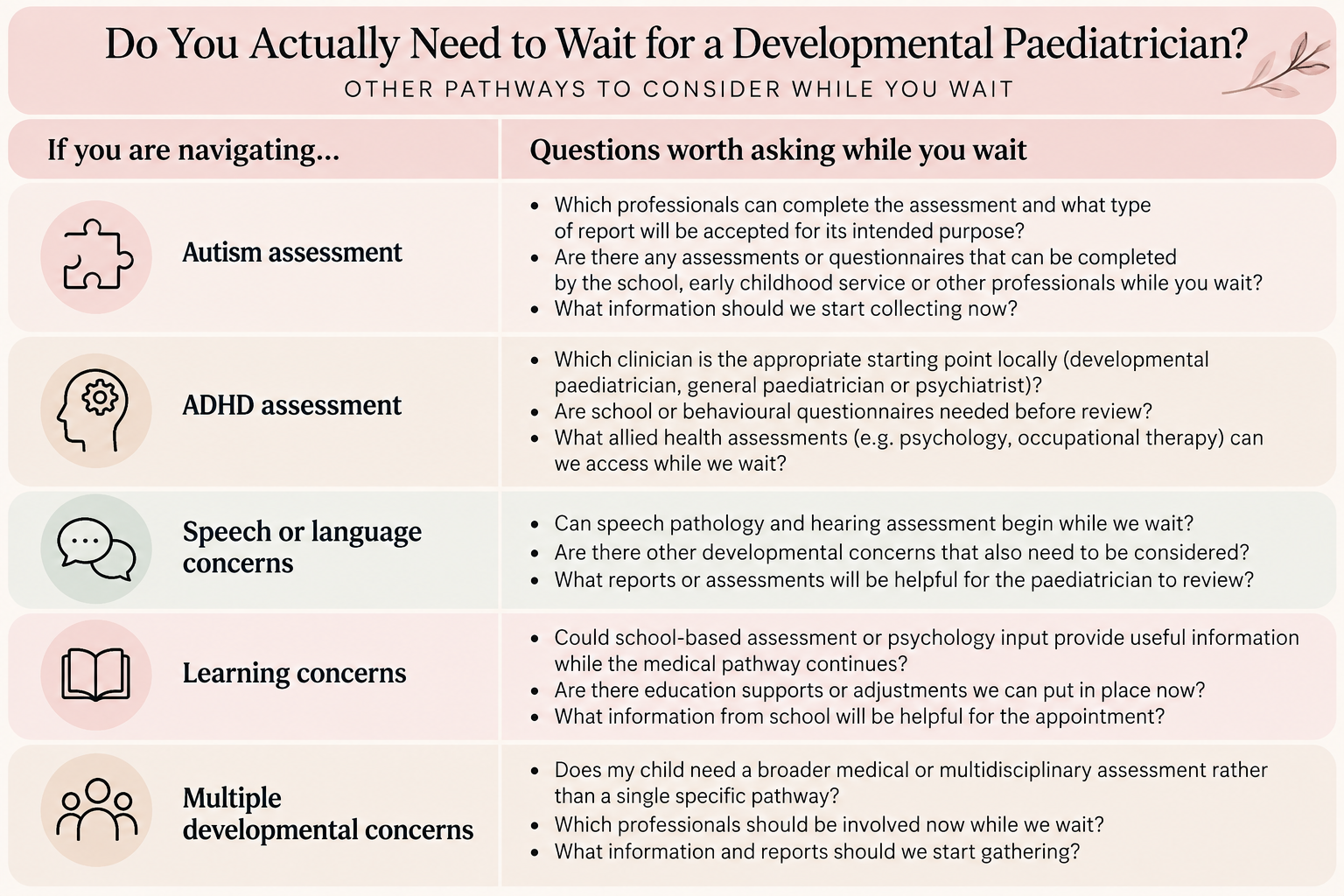
Do You Actually Need to Wait for a Developmental Paediatrician?
Sometimes the answer is yes. Sometimes another assessment or support pathway can begin while you wait. The important question is not simply "Who can diagnose this?" but "What does my child need assessed or supported, and what documentation do we actually need?"
The appropriate pathway depends on the concern, the child's age and complexity, local services, and the purpose of the assessment. Use the table below as a list of questions to discuss with your GP or treating team - not as a substitute for individual clinical advice.
How to Improve the Referral and Appointment Process
There is no guaranteed way to shorten a developmental paediatrician waitlist. But there are practical steps that can reduce avoidable delays and help the receiving service understand the reason for referral.
Ask your GP to clearly describe the concerns, how long they have been present and how they affect everyday functioning.
Include relevant reports from childcare, school, therapists and previous clinicians when the service requests or accepts them.
Explore both public and private options where appropriate.
Contact several private clinics and ask about cancellation lists.
Check whether the clinic expects particular questionnaires, hearing assessment or other information before the appointment.
Return intake forms and consent forms promptly.
Keep your contact details current with the clinic.
Update your GP if the situation changes significantly while you wait.
What Can You Do While Waiting?
Waiting for a developmental paediatrician does not always mean every other form of support has to wait too. Depending on your child's needs, your GP or treating team may discuss allied health, hearing assessment, school or childcare supports, community services or other assessments while the specialist pathway continues.
Collect useful information
Useful records may include:
school or childcare reports
reports from treating therapists
a timeline of concerns and previous referrals
examples of how concerns affect daily functioning
relevant questionnaires or developmental checklists
a list of strategies or supports already tried and whether they helped
Keep records focused and relevant. The goal is not to build the biggest folder possible; it is to help clinicians see the pattern, functional impact and changes over time.
What If Your Child's Needs Change While Waiting?
A referral describes your child's situation at a particular point in time. If their needs, functioning or circumstances change significantly, return to the referring GP for reassessment rather than assuming the original referral must remain unchanged.
Your GP can decide whether updated clinical information should be sent to the receiving service, whether another pathway should be considered, or whether more immediate assessment is needed.
Related guide: What to Do While Waiting for a Paediatrician Appointment in Australia
Where Does the NDIS Fit?
Families sometimes assume they must wait for a developmental paediatrician or a particular diagnosis before they can explore disability or early-childhood supports. NDIS access and evidence requirements depend on the child's circumstances and the rules in force at the time, and those requirements can change.
If the NDIS is part of the reason you are seeking assessment, check the current requirements directly and ask prospective clinicians what documentation their assessment will provide. A diagnosis and functional evidence are not the same thing, so clarify what evidence is actually needed for the purpose you are pursuing.
Free: Paediatrician Appointment Prep Sheet
Finally got an appointment after a long wait?Use the free one-page Paediatrician Appointment Prep Sheet to organise your top concerns, important changes, medications, specialists, recent investigations, questions and next steps before you go.
Frequently Asked Questions
Can my GP refer to both public and private developmental paediatric services?
Depending on the services involved, your GP may be able to provide referrals to both pathways. Each service has its own intake requirements, so confirm what is needed and whether remaining on one waitlist affects the other.
Can support start before my child has a diagnosis?
Some supports can be based on a child's functional or developmental needs rather than waiting for a formal diagnosis. Ask your GP, treating professionals, school or relevant service what can appropriately begin while assessment is pending.
Does private health insurance cover developmental paediatrician appointments?
Routine outpatient specialist consultations are generally different from hospital admissions for private health insurance purposes. A Medicare rebate may apply to an eligible specialist consultation with a valid referral, but families may still have an out-of-pocket cost. Check the expected fee and rebate with the practice before booking.
How long are developmental paediatrician waiting lists?
Waiting times vary substantially by location, service, clinician and type of assessment. Ask each service for its current estimate rather than relying on a general national figure.
Do I always need a developmental paediatrician for an autism assessment?
Not always. Assessment pathways can involve different appropriately qualified professionals or multidisciplinary teams. Ask what pathway is appropriate for your child and what documentation is required for the purpose of the assessment.
Key Takeaways
Confirm that a referral has been received and accepted rather than assuming your child is on a waitlist.
Ask about public and private pathways, cancellation lists and current waiting times.
A developmental paediatrician is not always the only assessment pathway.
Find out what reports or assessments the receiving service needs before the appointment.
Use the waiting period to gather relevant information and explore appropriate supports.
Return to your GP if your child's needs or functioning change while waiting.
Related Guides
Can Your GP Refer to Public AND Private Specialists at the Same Time?
What to Do While Waiting for a Paediatrician Appointment in Australia
Health information disclaimer: Navigate Child Health Australia provides general information to help Australian families understand and navigate the healthcare system. This article does not provide individual medical advice and does not replace assessment, diagnosis or treatment from a qualified healthcare professional. Service pathways, referral requirements and eligibility rules vary and may change.
