
How to Get a Paediatrician Appointment Faster in Australia
If you've been told you'll need to wait months—or even longer—to see a paediatrician, there may be more options available than simply waiting for your appointment.
Depending on your child's situation, you may be able to:
ask your GP about both public and private referral pathways
contact multiple private paediatricians to compare wait times
ask to be placed on cancellation lists
confirm that a public referral has been received and accepted
return to your GP if your child's condition changes while waiting
ask whether new clinical information should be added to the referral
investigate whether another specialist or allied health professional can help while you wait.
None of these strategies can guarantee an earlier appointment. But understanding how the Australian referral system works can help you avoid unnecessary delays and identify options you may not have realised were available.
This guide walks you through those options step by step.
Start Here: Already Have a Paediatrician Referral?
If you already have a referral and the wait is much longer than expected, start with these questions:
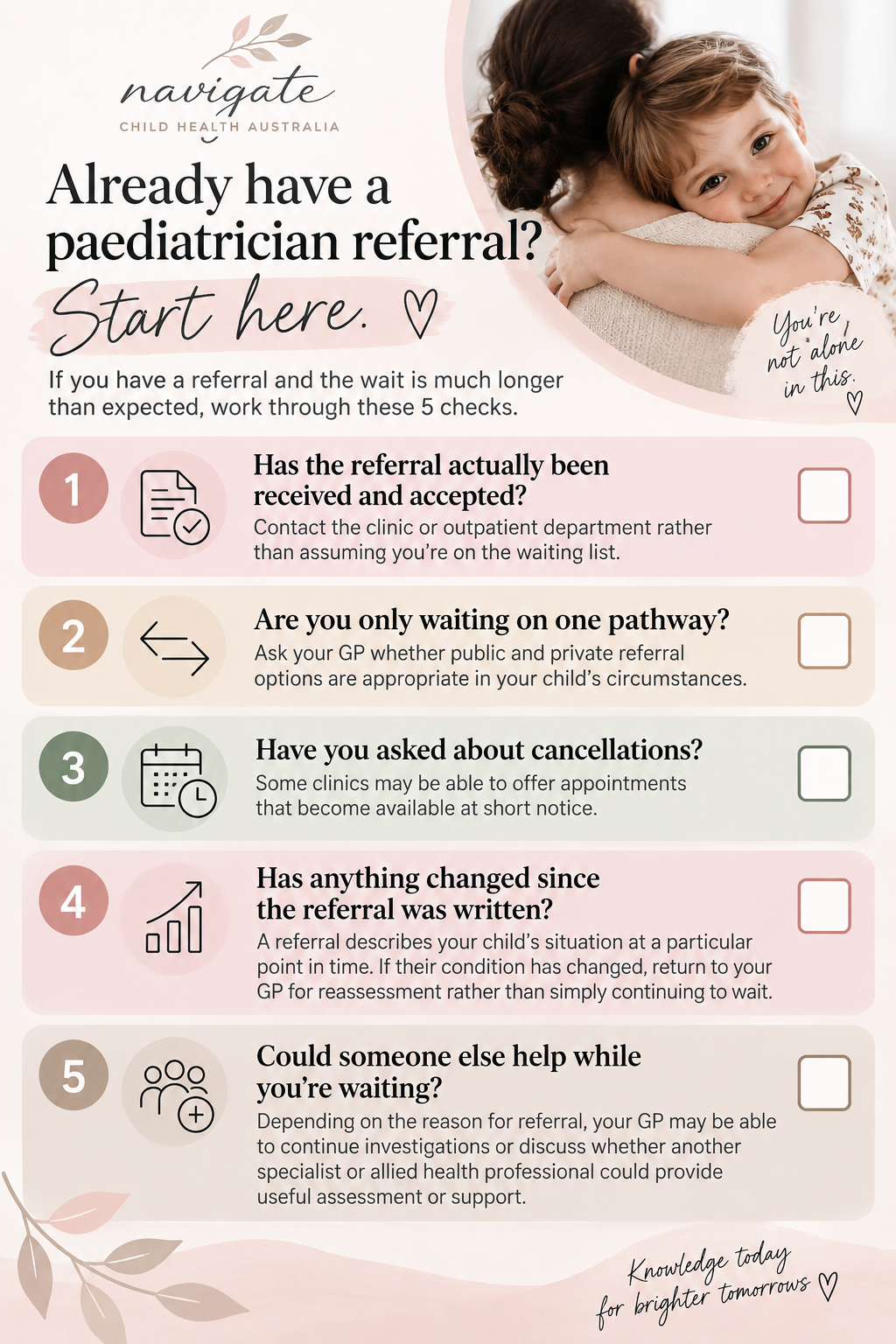
1. Has the referral actually been received and accepted?
Contact the clinic or outpatient department rather than assuming you're on the waiting list.
2. Are you only waiting on one pathway?
Ask your GP whether public and private referral options are appropriate in your child's circumstances.
3. Have you asked about cancellations?
Some clinics may be able to offer appointments that become available at short notice.
4. Has anything changed since the referral was written?
A referral describes your child's situation at a particular point in time. If their condition has changed, return to your GP for reassessment rather than simply continuing to wait.
5. Could someone else help while you're waiting?
Depending on the reason for referral, your GP may be able to continue investigations or discuss whether another specialist or allied health professional could provide useful assessment or support.
Then keep reading—the sections below explain each of these options and how the Australian paediatric referral system works.
If you are waiting for a paediatrician appointment you might find out free Paediatrician Appointment Prep sheet useful.
Why is it so hard to get a paediatrician appointment in Australia?
Across Australia, demand for paediatric specialists has increased significantly over recent years. At the same time, the number of available appointments has struggled to keep pace. Depending on where you live and the type of paediatrician your child needs, waiting lists can range from several months to well over a year.

Where you live matters
Families living in regional and rural Australia often have fewer paediatricians available locally. This can mean longer travel distances, fewer appointment options and longer waiting times than those experienced in metropolitan areas.
Not every referral is seen in the order it arrives
In reality, paediatric services assess referrals according to clinical urgency. Children with conditions considered more urgent may be prioritised ahead of referrals received earlier. This process is known as triage.
Understanding how referrals are prioritised is one of the reasons learning how the system works can be so valuable.
For more information on referrals see our guide here: Do You Need a Referral to See a Paediatrician in Australia? (And How to Get One Faster)
8 Things you can do while waiting for a paediatrician
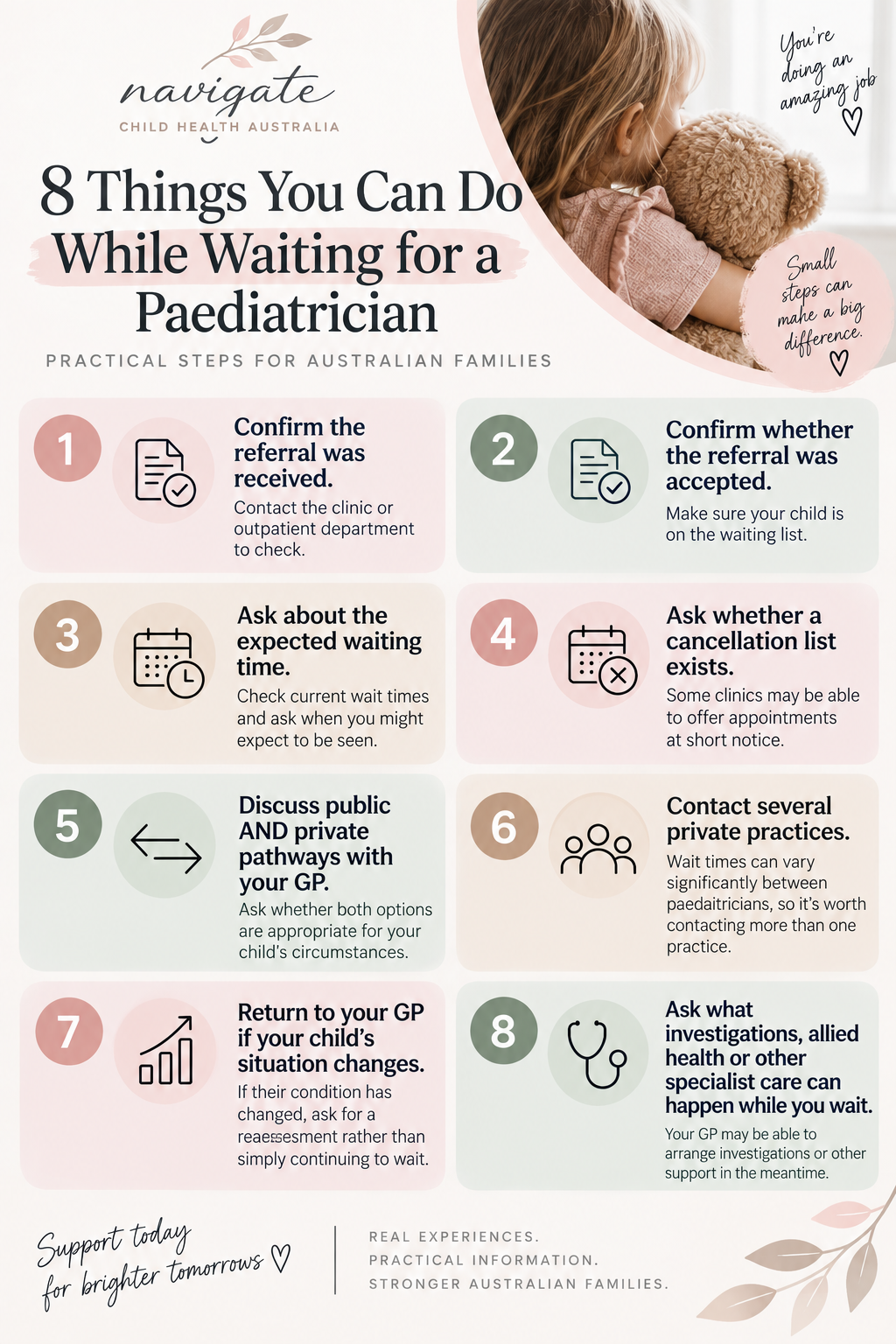
Confirm the referral was received
Confirm whether the referral was accepted
Ask about the expected waiting time
Ask whether a cancellation list exists
Discuss public AND private pathways with your GP
Contact several private practices rather than assuming their waitlists are the same
Return to your GP if your child's situation changes
Ask what investigations, allied health or other specialist care can happen while you wait.
Not every child needs a paediatrician
It's also important to remember that a referral isn't always the first or only step.
Depending on your child's symptoms, your GP may recommend:
Observation and follow-up
Initial investigations such as blood tests or imaging
Referral to an allied health professional, such as a speech pathologist, occupational therapist, physiotherapist or psychologist
Hearing or vision assessments
Treatment trials
Referral to another specialist if they are better placed to manage your child's condition
Sometimes these early steps provide the answers. Other times, they help build a clearer picture that supports a paediatric referral if one is needed. Given the length of time it takes to get a Paediatrician appointment, it is often an appropriate course of action to request your GP make the paediatrician referral whilst undertaking these additional measures. Your referral can also be withdrawn at any time should you no longer require it. This is particularly worth considering if you live regionally or remotely in Australia and are likely to face very lengthy waiting lists to see a Paediatrician.
How the Australian Paediatric Referral System Actually Works
One of the biggest frustrations for parents is that the paediatric referral process often feels like a mystery.
You visit your GP, they write a referral, and then... nothing.
Weeks or months can pass without hearing anything, leaving many parents wondering whether the referral was received, whether they're on a waiting list, or whether they've somehow fallen through the cracks.
Understanding what usually happens after your GP presses "send" can make the waiting process a little less overwhelming and help you know when it's appropriate to follow up. See our summary flow chart below for the details of what happens.
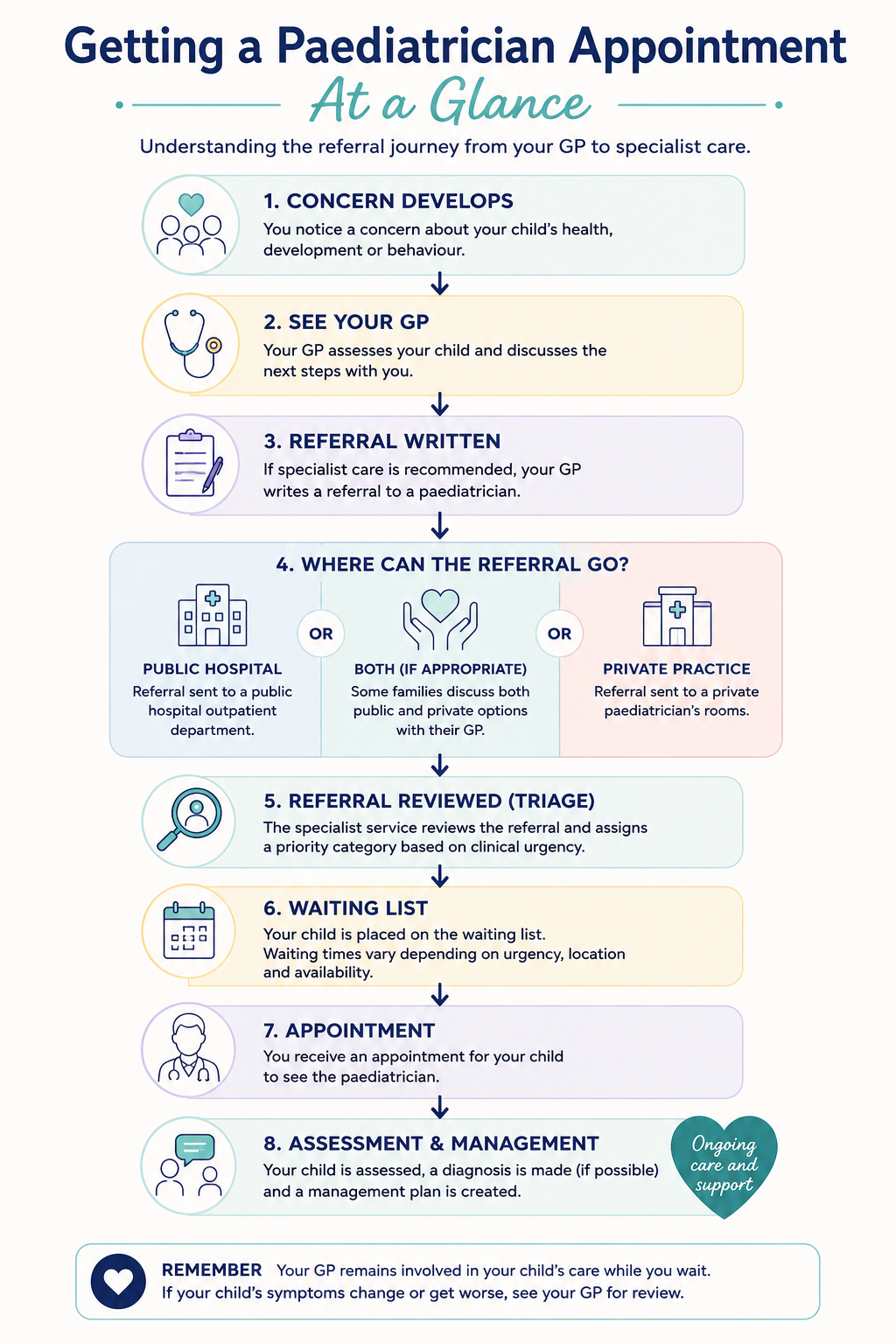
Want the referral process explained in detail? See our guide below on How to get a Paediatrician referral
Can I follow up on my referral?
Yes.
Many parents worry they'll be seen as "difficult" if they contact the hospital or specialist's rooms.
In reality, it's completely reasonable to:
check that your referral has been received
ask whether it has been accepted
confirm you're on the waiting list
update your contact details
ask what to do if your child's condition changes while you're waiting.
Following up doesn't guarantee an earlier appointment, but it can give you peace of mind that your referral hasn't been delayed because of an administrative issue.
What if my child's condition changes?
This is one of the most important things parents should know.
Your referral reflects your child's condition at the time it was written.
If your child's symptoms become significantly worse while you're waiting, it's important to return to your GP rather than assuming you simply need to wait longer.
Your GP can reassess your child, arrange further investigations if needed, update your referral with new clinical information or discuss whether a different pathway is now appropriate.
Many parents don't realise that referrals can sometimes be reviewed again if there has been a meaningful change in a child's condition.
That's why it's so important to continue seeing your GP while you're waiting rather than thinking the referral process is now out of your hands.
Public vs Private Paediatricians: Which Pathway Is Right for Your Child?
One of the first decisions many parents face is whether to see a paediatrician through the public health system or book an appointment with a private paediatrician.
There isn't a single "right" answer.
Public paediatricians
Public paediatricians usually work through children's hospitals or public hospital outpatient clinics.
If your child is accepted onto a public waiting list, appointments are generally covered by Medicare, meaning there is usually no out-of-pocket cost for specialist consultations.
Advantages of the public system
The public system offers several important benefits:
Specialist care with little or no direct cost to families.
Access to multidisciplinary teams in many hospitals, including allied health professionals and other paediatric specialists.
Easier coordination of care if your child has complex medical needs requiring input from multiple hospital services.
Ongoing access to hospital-based investigations and specialist clinics where appropriate.
For children with complex or ongoing medical conditions, public hospitals can provide coordinated care that extends well beyond a single specialist appointment.
Things to consider
Public services are also managing high demand.
Depending on where you live and the reason for referral, waiting times may be longer than those available privately. Public referrals are generally prioritised according to clinical need rather than the order in which they are received, so children with more urgent conditions may be seen ahead of others.
This can understandably be frustrating for families whose child has significant concerns but whose condition is not considered medically urgent.
Private paediatricians
Private paediatricians work from private consulting rooms and usually require payment for consultations.
Many private paediatricians charge fees above the Medicare rebate, meaning there is often an out-of-pocket cost. Fees and waiting times vary considerably between practices.
Advantages of the private system
For some families, the private system may offer:
Shorter waiting times in some areas.
Greater choice of paediatrician.
More flexibility in appointment availability.
The opportunity to seek a second opinion if appropriate.
However, shorter waiting times are not guaranteed. Some private paediatricians also have lengthy waiting lists, particularly for developmental and behavioural assessments.
When deciding on private or public care, it is also useful to consider that a lot of private specialists will also work in the public system. So it is possible to see the same specialist on either pathway. There may just be more choice and control in one pathway rather than the other.
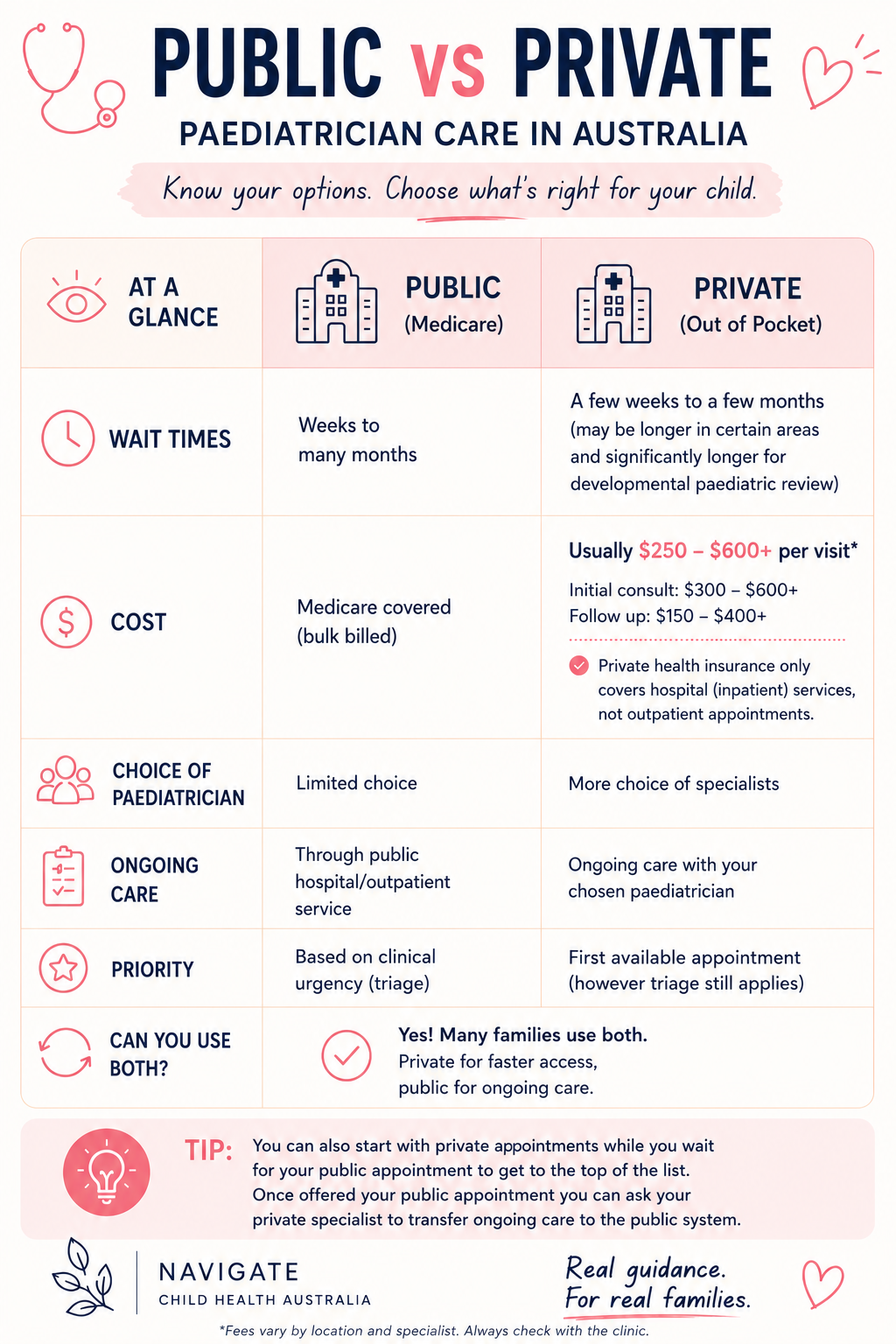
If you are interested to learn more about Private vs Public Paediatric care see our guide: Public vs Private Paediatric Care in Australia: What parents need to know
Can you use both pathways?
Many parents are surprised to learn that public and private care are not always mutually exclusive.
In some situations, families may explore both pathways rather than relying on just one.
Exactly how this works depends on your child's circumstances, your GP's clinical judgement and the services available in your area.
Because this is an area that causes a great deal of confusion, we've dedicated a guide which you can access here: Can Your GP Refer to Both Public and Private Specialists at the Same Time? (Australia Guide)
What if I can't afford private care?
This is an important question.
Many Australian families simply cannot afford hundreds of dollars in specialist fees, particularly if multiple appointments or ongoing care are needed.
If private care isn't financially realistic for your family, you're not alone.
Speak openly with your GP about your situation.
There may be other options to help support your child while you're waiting, including:
regular GP reviews
referrals to appropriate allied health professionals (in certain circumstances your GP may be able to make a “care plan” for your child to enable you to be able to access medicare rebates)
community child health services
hospital outpatient services
additional investigations where appropriate
a review of your referral if your child's condition changes.
Waiting for a paediatrician does not mean your child's healthcare has to be put on hold.
Your referral isn't set in stone
One of the biggest misconceptions is that once a referral has been sent, nothing else can happen until the appointment arrives.
In reality, your child's healthcare journey continues.
If your child's symptoms improve, your GP may recommend ongoing management without specialist review.
If your child's condition changes or new concerns develop, your GP can reassess them, arrange further investigations where appropriate and discuss whether additional information should be provided to the receiving service.
Keeping your GP involved throughout the waiting period is one of the most valuable things you can do.
The goal isn't to "beat the system"
Parents sometimes tell me they feel guilty asking questions or following up because they don't want to seem pushy.
I don't see it that way.
Advocating for your child isn't about jumping the queue or taking someone else's place.
It's about making sure:
your referral has reached the right service
the information accurately reflects your child's current situation
you understand your options
your child receives the most appropriate care.
Good advocacy is informed, respectful and collaborative.
The healthcare system works best when parents, GPs and specialists work together as a team.
In the next section, we'll explain how public paediatric referrals are prioritised, what referral categories mean and why two children referred on the same day may have very different waiting times.
How Are Paediatric Referrals Prioritised?
One of the most confusing parts of the paediatric referral process is understanding why some children are seen within weeks, while others wait many months—or even longer.
It's natural to wonder:
Did something go wrong with my referral?
Have we been forgotten?
Why was another child seen before mine?
In most public health services, referrals are not simply processed in the order they arrive.
Instead, they are usually reviewed and prioritised according to clinical need through a process known as triage.
Understanding how triage works can help make the waiting process feel a little less confusing and help you know when it's appropriate to seek further review.
What is triage?
Triage is the process of assessing how urgently a child needs specialist assessment based on the information available at the time the referral is reviewed.
The clinician reviewing your referral is trying to answer questions such as:
How unwell is this child?
Could waiting cause harm?
Are there signs that urgent specialist assessment is needed?
Can this child safely continue to be managed by their GP while waiting?
Is a paediatrician the most appropriate specialist for this concern?
This decision is based on the clinical information provided in the referral—not on how long you've been waiting or how worried you are.
That doesn't mean your concerns aren't valid. It simply means the referral is being prioritised according to the child's clinical needs as they appear at that point in time.
What do Category 1, Category 2 and Category 3 mean?
Many public paediatric services use referral categories to help prioritise appointments.
The exact names, criteria and expected waiting times vary between hospitals and states, but they generally reflect how urgently specialist review is needed.
As a general guide:
Higher priority referrals are usually for children whose symptoms suggest they need specialist assessment urgently because delaying care may place them at greater risk.
Intermediate priority referrals are for children who should be seen sooner rather than later, but whose condition is considered stable enough to wait for an outpatient appointment.
Lower priority referrals are for children whose condition is considered appropriate to manage through their GP or other healthcare providers while waiting for specialist review.
It's important to remember that these categories are based on clinical urgency, not on whose family is struggling the most.
The referral category is not a measure of how much your family is struggling
This is something many parents tell me they find difficult.
If your child is placed into a lower-priority category, it can feel as though someone has decided your concerns aren't important.
That isn't what triage is intended to do.
A child can have a condition that places enormous emotional, financial and practical pressure on a family, while still being considered medically safe to wait for outpatient review.
For example, a baby who cries for many hours each day may completely exhaust their parents and have a profound impact on family life. That experience is real, valid and deserving of support. However, if the baby is feeding well, gaining weight and has no signs of serious illness, the referral may still be considered appropriate for routine outpatient assessment.
On the other hand, a child with the same diagnosis who is losing weight, becoming dehydrated or repeatedly presenting to hospital may require much more urgent review.
Both families need support. The difference is the level of medical urgency.
What information helps clinicians understand my child's situation?
A well-written referral helps the reviewing clinician understand not only what is happening, but how it is affecting your child.
Depending on the reason for referral, this may include information such as:
the history and duration of symptoms
examination findings
growth or weight concerns
results of relevant investigations
treatments that have already been tried
whether symptoms are improving or worsening
the impact on feeding, sleep, school or everyday activities
recommendations from other healthcare professionals where relevant.
This isn't about making a referral sound more serious than it is.
It's about making sure it accurately reflects your child's current situation.
Can my referral category change?
Yes—sometimes.
A referral reflects your child's condition on the day it was written.
If your child's condition changes significantly while you're waiting, it's important to return to your GP rather than assuming you simply have to keep waiting.
Your GP can reassess your child and, if appropriate, provide updated clinical information to the receiving service.
Examples of changes that may warrant review include:
significant deterioration in symptoms
poor weight gain or weight loss
repeated emergency department presentations
new investigation results
failure to respond to treatment
new concerns identified by your GP or other treating health professionals.
Whether this changes your referral priority depends on your child's individual circumstances and the clinical assessment of the receiving service.
What if the waiting period is becoming unsafe?
One of the most important messages I want parents to take away from this guide is that being on a waiting list should never prevent you from seeking medical care if your child's condition changes.
You do not need to wait for your paediatrician appointment if:
your child's symptoms are worsening
new concerning symptoms develop
your child is no longer feeding or drinking adequately
you're worried about dehydration, breathing, severe pain or reduced responsiveness
your child requires repeated urgent medical reviews
you feel the situation has become unsafe to manage at home.
Sometimes the concern isn't only your child's medical condition.
Sometimes it's that the situation has reached a point where you, as the parent or carer, are no longer able to safely continue caring for your child without additional medical support.
If that's the case, seek help.
Depending on your child's circumstances, that may mean contacting your GP urgently, attending an emergency department, using your state's Virtual Emergency Department if available, or calling emergency services if there is an immediate threat to life.
Asking for help because a situation has become unsafe is not overreacting—it is an appropriate part of caring for your child.
Our guide may assist: When Should You Go to Emergency While Waiting for a Paediatrician? (Australia Guide)
7 Practical Ways to Help Your Child Access the Right Care Sooner
No one can guarantee an earlier paediatrician appointment.
However, there are practical steps that may help ensure your child is on the most appropriate pathway, that their referral accurately reflects their needs, and that opportunities for earlier assessment aren't missed.
Think of these strategies as ways to navigate the system, not to jump the queue.
1. Start with a GP who knows your child's story
Your GP is one of the most important people in your child's healthcare journey.
Whether it's a long-standing family GP or another doctor who has taken the time to understand your child's situation, continuity of care can make a real difference.
A GP who knows your child is often better placed to recognise when symptoms are changing, coordinate investigations, monitor progress and provide updated clinical information if needed.
If you're seeing different doctors each visit, consider asking whether one GP can become your child's primary doctor for ongoing care.
2. Make sure your referral tells the whole story
A referral should do more than simply list a diagnosis.
It should help the reviewing clinician understand:
what is happening
how long it has been happening
what treatments have already been tried
how your child's symptoms are affecting their health and daily life
why specialist assessment is being requested.
This isn't about making your child's situation sound worse than it is.
It's about ensuring the referral accurately reflects your child's current circumstances.
If you're unsure whether your referral contains enough information, ask your GP if they can explain what has been included. It is also advisable to ask for a copy of the referral which will enable further follow up as necessary.
3. Keep seeing your GP while you're waiting
One of the biggest mistakes parents make is assuming that once the referral has been sent, there's nothing more they can do until the appointment arrives.
In reality, your GP should remain actively involved.
Regular review appointments allow your GP to:
monitor your child's progress
assess whether treatment is helping
arrange further investigations if needed
identify any new concerns
update your referral if your child's condition changes.
Waiting for a specialist should never mean your child's healthcare is put on hold.
4. Keep a record of what is happening
Parents often notice patterns that are difficult to remember months later.
Keeping a simple record can be incredibly helpful.
Depending on your child's condition, this might include:
symptom diaries
growth or weight records
photos (where appropriate)
short videos of concerning symptoms
medication responses
emergency department visits
hospital admissions
reports from childcare, kindergarten or school.
These records can help both your GP and your paediatrician understand the overall picture.
5. Ask what can happen while you're waiting
A paediatrician isn't always the first professional who can help.
Depending on your child's symptoms, your GP may recommend other assessments or supports while you're waiting, such as:
speech pathology
occupational therapy
physiotherapy
psychology
hearing assessments
vision assessments
lactation support
dietetics
community child health services.
Starting these supports early may help your child and provide valuable information for the paediatrician when your appointment arrives.
6. Follow up appropriately
If you haven't heard anything after your referral has been sent, it's reasonable to check that everything has been received.
You might contact the specialist rooms or hospital outpatient department to ask:
Has my referral been received?
Has it been reviewed?
Am I on the waiting list?
Is there anything further you need from my GP?
What should I do if my child's condition changes?
How long is the anticipated wait time?
Following up respectfully won't necessarily shorten the wait, but it can prevent unnecessary delays caused by administrative issues.
7. Know when waiting is no longer the safest option
Being on a waiting list does not mean you have to simply wait regardless of what happens next.
If your child becomes significantly more unwell, develops new symptoms or the situation becomes unsafe, seek medical advice promptly.
That may involve:
seeing your GP urgently
attending an emergency department
using your state's Virtual Emergency Department where available
contacting your treating team if you're already under specialist care.
Sometimes the biggest change isn't your child's diagnosis—it's that the overall situation has changed.
For example:
your child may no longer be feeding safely
repeated hospital visits may be occurring
symptoms may be escalating despite treatment
you may no longer be able to safely care for your child at home because of exhaustion or the intensity of their needs.
If that's happening, don't wait for your specialist appointment before asking for help. If you are not sure what is the best pathway to access support this guide may help: Should I Take My Child to Hospital, Urgent Care, GP or Virtual ED? (Australia Guide)
Remember: good advocacy is about sharing accurate information
Parents sometimes worry that advocating for their child means they have to fight the system.
In reality, the most effective advocacy is usually calm, informed and collaborative.
Your role isn't to convince someone that your child is sicker than they are.
Your role is to make sure the healthcare team has an accurate, up-to-date understanding of your child's situation so they can make the best clinical decisions possible.
The next question many parents ask is:
"What should I actually be doing while we're waiting for the appointment?"
That's exactly what we'll cover in the next section.
What to Do While You're Waiting for a Paediatrician Appointment
For many families, the waiting period is the hardest part of the journey.
It can feel as though everything is on hold while you wait for someone else to tell you what to do next.
The good news is that, in most situations, there are important things you can do while you're waiting. Your child's healthcare doesn't stop simply because you're waiting for a specialist appointment.
Keep your GP involved
Your GP remains an essential part of your child's healthcare while you're waiting to see a paediatrician.
Regular review appointments allow your GP to:
monitor your child's progress
assess whether current treatments are working
organise further investigations if appropriate
identify any changes that may require earlier review
coordinate referrals to other health professionals.
Think of your GP as your child's healthcare coordinator rather than simply the person who wrote the referral.
Continue any recommended treatments
Unless you've been advised otherwise by your treating healthcare team, continue with the management plan recommended by your GP or other health professionals.
This may include:
prescribed medications
feeding plans
dietary advice
physiotherapy exercises
speech therapy activities
occupational therapy strategies
behavioural strategies
sleep plans.
If something isn't working, don't simply wait for the paediatrician appointment. Make another appointment with your GP to discuss what is happening.
Our guide What To Do While Waiting for a Paediatrician Appointment in Australia might be helpful.
Gather useful information
One of the most valuable things you can do while waiting is build a clear picture of your child's symptoms.
Depending on your child's condition, this might include:
a symptom diary
growth or weight records
feeding records
sleep patterns
videos of concerning symptoms
a list of medications or treatments you've tried
a timeline of appointments, investigations and hospital visits.
This information can help your paediatrician understand your child's journey much more quickly at your first appointment.
Listen to the people who know your child
If your child attends childcare, kindergarten or school, educators may notice patterns that are helpful to share with your healthcare team.
For example, they may observe:
learning difficulties
social interactions
communication skills
behaviour
attention and concentration
physical abilities
eating or toileting concerns.
Their observations can provide valuable information alongside what you see at home.
Access other supports where appropriate
Depending on your child's needs, your GP may recommend seeing other healthcare professionals before your paediatrician appointment.
This may include:
speech pathologists
occupational therapists
physiotherapists
psychologists
dietitians
lactation consultants
hearing or vision services
community child health services.
Starting these supports early doesn't replace seeing a paediatrician, but it may help your child sooner and provide useful information for the specialist assessment.
Look after yourself as well
Parents often put all their energy into caring for their child and forget that they need support too.
Waiting for answers can be emotionally exhausting.
If you're struggling, tell someone.
Speak with your GP, reach out to trusted family or friends if you have them, or ask what local supports are available.
Looking after yourself isn't taking attention away from your child—it's an important part of being able to continue caring for them.
Know when to seek further medical care
Waiting for a specialist appointment should never stop you from seeking medical advice if your child's condition changes.
Return to your GP promptly if:
symptoms become significantly worse
new symptoms develop
treatments are no longer working
your child is losing weight or not growing as expected
you're increasingly worried about your child's health.
Seek urgent medical assessment if your child develops symptoms that require immediate attention, or if you feel the situation has become unsafe to manage at home.
You do not need to wait for your paediatrician appointment before asking for help.
Prepare for your first appointment
When your appointment finally arrives, being organised can help you get the most from it.
Before the appointment, consider bringing:
your child's health record (if relevant)
a list of medications and supplements
copies of important test results or reports
growth records if you have them
a timeline of your child's symptoms
questions you'd like answered.
Many parents find it helpful to write their questions down beforehand. It's easy to forget something important once you're in the consultation.
Remember, you don't need to solve everything before you see the paediatrician.
Your goal during the waiting period is simply to ensure your child continues receiving appropriate care, to monitor for any significant changes, and to arrive at the appointment with a clear picture of what has been happening.
In the next section, we'll answer some of the most common questions parents ask about paediatric referrals, waiting lists and specialist appointments.
FAQ’s
Can my GP refer my child to more than one paediatrician?
Depending on your child's circumstances and your GP's clinical judgement, this may be possible. Some families discuss both public and private referral options with their GP. The most appropriate pathway will depend on your child's needs, local services and your family's circumstances.
Can I be on more than one waiting list?
This depends on the service, your location and how referrals are managed in your area. If you're unsure, discuss your options with your GP or ask the receiving specialist service how their waiting list operates. Generally , you will be able to remain on the public waitlist whilst seeing a private specialist and then transfer care to the public system once you receive an appointment.
Can I change paediatricians after I've already been referred?
Yes, in some situations this may be possible. Parents sometimes change specialists because they move, waiting times differ or another paediatrician is a better fit for their child's needs. Speak with your GP about the most appropriate next step.
What happens if my child gets worse while we're waiting?
Don't assume you have to wait for your appointment.
Return to your GP for reassessment. Depending on what has changed, your GP may recommend further investigations, update your referral or arrange urgent medical assessment.
If your child requires immediate medical attention, seek emergency care.
Should I keep calling the hospital every week?
Generally, no.
However, it is completely reasonable to contact the hospital or specialist's rooms to:
confirm your referral has been received
check that you're on the waiting list
update your contact details
ask what to do if your child's condition changes.
Frequent calls are unlikely to change your child's position on the waiting list unless there has been a significant change in their clinical circumstances.
What if I can't afford a private paediatrician?
Many Australian families are in this situation.
Talk openly with your GP about your circumstances. They may be able to recommend public services, community supports, allied health professionals or other management strategies while you're waiting.
Your inability to pay privately should never stop you seeking healthcare for your child.
Can my referral category change?
Sometimes.
If your child's condition changes significantly after the referral has been written, your GP can reassess your child and discuss whether updated clinical information should be provided to the receiving service.
Any change in priority is based on clinical assessment rather than simply the amount of time you've been waiting.
What if my GP doesn't think my child needs a paediatrician?
Ask questions.
Understanding why your GP has reached that conclusion is an important first step.
If you're still concerned after discussing your child's symptoms, it's reasonable to arrange a review appointment or seek a second medical opinion.
Good healthcare decisions are made through open conversations, not assumptions.
What if I don't agree with the treatment plan?
It's okay to ask questions.
Ask your healthcare team:
Why is this the recommended approach?
Are there other options?
What should I watch for?
When should I come back?
What would change the plan?
Understanding the reasoning behind a treatment plan often helps parents feel more confident about the next steps.
Will seeing allied health delay my paediatrician appointment?
Usually not.
In fact, depending on your child's needs, early input from professionals such as speech pathologists, occupational therapists or physiotherapists may help your child sooner and provide valuable information for the paediatrician when your appointment arrives.
What if no one seems to be listening?
This can be one of the most difficult parts of being a parent.
If you're worried your child's condition is changing, keep seeking medical review.
Sometimes the most important piece of information is that your child's story has changed since the original referral.
You don't need to wait quietly if your concerns are increasing.
When should I go to hospital instead of waiting for my appointment?
A paediatrician appointment is designed to provide specialist outpatient care.
If your child becomes acutely unwell, develops concerning symptoms or you believe they require urgent medical assessment, seek immediate medical care rather than waiting for your specialist appointment.
If you're ever unsure, contact your GP, use your state's Virtual Emergency Department where available, or attend your nearest emergency department.
What's the most important thing I can do while waiting?
Stay connected with your GP.
Your GP remains your child's primary healthcare provider while you're waiting for specialist review.
Keep them updated, attend review appointments and let them know if your child's condition changes.
The best outcomes usually come from families and healthcare professionals working together—not from trying to navigate the system alone.
If there's one thing I hope you take away from this guide, it's that being placed on a waiting list doesn't mean your child's healthcare has stopped. You are not expected to simply wait in silence. Your GP is still there. Your child can still be reviewed. Your concerns can still be heard. And if your child's condition changes—or the situation becomes unsafe—you should seek help. Good navigation isn't about pushing to the front of the queue. It's about making sure your child receives the right care at the right time.
