
Should I Take My Child to Hospital, Urgent Care, GP or Virtual ED? (Australia Guide)
Parents are constantly expected to make impossible decisions when their child gets sick.
Should you wait for a GP appointment?
Go straight to Emergency?
Try Urgent Care?
Use Virtual ED first?
And when it’s a baby — especially a newborn — the pressure feels even heavier.
Many parents end up googling things like:
“Should I take my baby to hospital?”
“Child fever when to go to emergency”
“Hospital or urgent care for baby?”
“Can urgent care see babies?”
“What is Virtual ED?”
“Should I go to emergency or GP?”
The reality is that Australia’s healthcare system can be incredibly confusing to navigate — especially when you’re sleep deprived, overwhelmed, and trying to decide whether your child is “sick enough.”
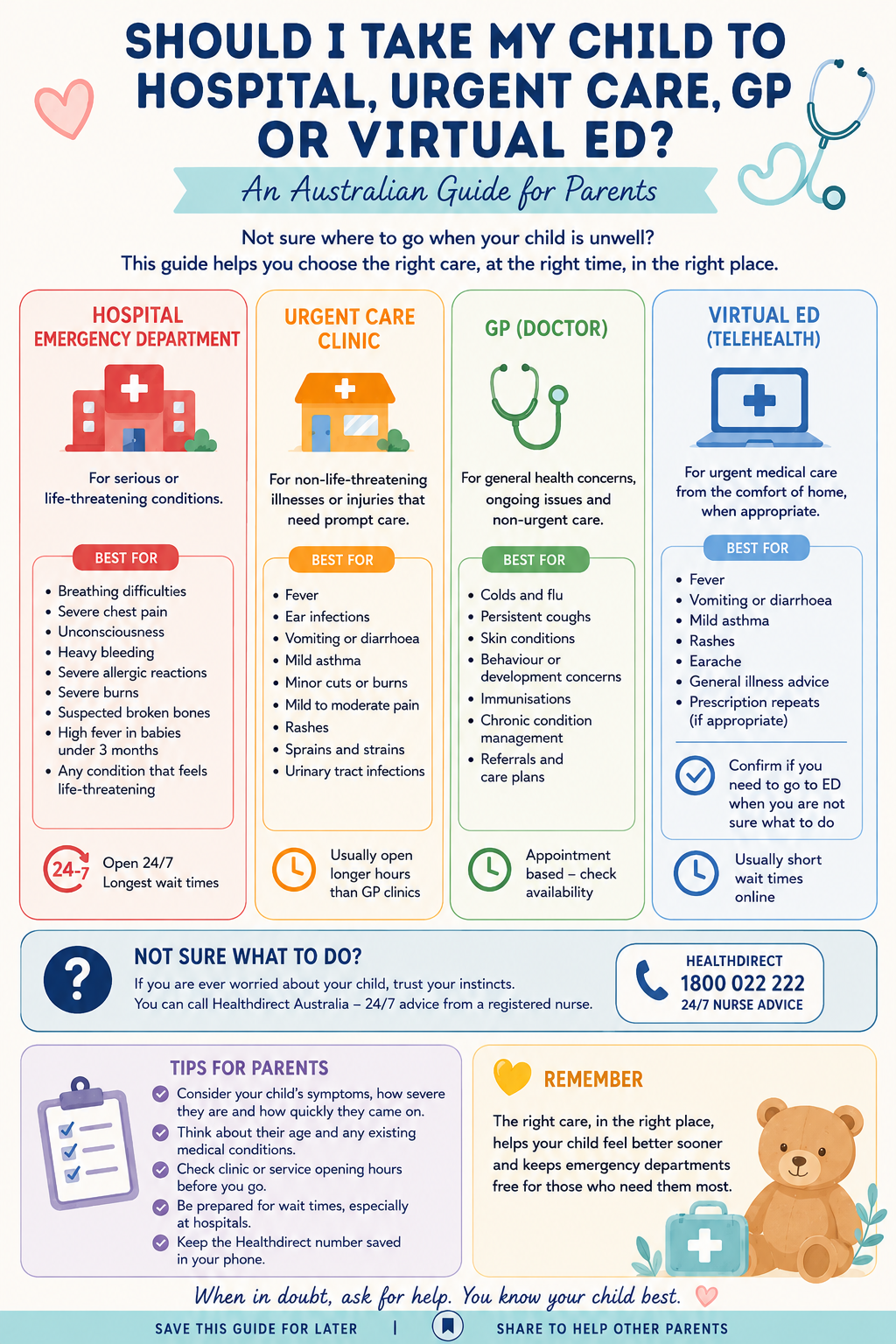
This guide explains the difference between GP clinics, Urgent Care, Emergency Departments and Virtual ED services in Australia — and what parents should know before deciding where to go.
When should you take a baby or child to hospital?
One of the hardest parts of parenting is trying to decide when something has crossed the line from “monitor at home” to “this needs hospital.”
The difficulty is that children can deteriorate quickly, particularly babies and younger children. Many parents also worry about:
being judged for “overreacting”
wasting hospital time
sitting in Emergency for hours unnecessarily
or missing something serious by staying home too long.
This is exactly why understanding the role of each healthcare service matters.
Emergency Departments are designed for:
serious illness
significant breathing concerns
dehydration
severe pain
injuries requiring hospital-level assessment
rapidly worsening conditions
situations where a child may need investigations, monitoring, oxygen, IV fluids or specialist input.
But not every sick child needs a hospital Emergency Department immediately — and not every child can safely wait for a standard GP appointment either.
That’s where understanding Urgent Care and Virtual ED becomes incredibly useful for parents.
If you are specifically trying to decide whether a fever needs hospital assessment, read our guide on when to take a baby or child to hospital for fever and how Virtual ED can help parents decide.
Should I go to emergency or urgent care?
This is one of the most searched parenting health questions in Australia right now.
Urgent Care Clinics sit somewhere between a GP clinic and a hospital Emergency Department.
They are designed for illnesses or injuries that are urgent, but not necessarily life-threatening.
Urgent Care can sometimes help families avoid long Emergency Department waits for things like:
minor injuries
simple fractures
infections
fevers
mild breathing illnesses
cuts requiring glue or stitches
ear infections
vomiting illnesses
rashes
minor burns.
However, one of the biggest things parents don’t realise is that not all Urgent Care clinics can see all ages.
This becomes extremely important for babies under 3 months old.
In Queensland particularly, many Satellite Hospitals and Urgent Care-style services will NOT assess babies under 3 months. Parents may arrive expecting help only to be redirected to a children’s Emergency Department.
This is why parents of very young babies need to check age criteria carefully before attending.
What is Virtual ED and when should parents use it?
Virtual ED is one of the most under-utilised parenting tools in Australia.
Virtual Emergency Departments allow families to speak with emergency-trained clinicians via video call from home.
Depending on the service and your state, Virtual ED may help parents:
decide whether their child needs hospital assessment
determine whether symptoms can safely be monitored at home
understand which service is most appropriate
avoid unnecessary Emergency Department presentations
receive advice about escalation pathways
decide whether overnight monitoring is reasonable
access reassurance when they are uncertain.
For many parents, the hardest part is not necessarily caring for the sick child itself — it’s the burden of decision-making.
Virtual ED can provide a “middle step” between:
panicking and rushing to hospital
versus staying home while feeling unsure.
Some parents use Virtual ED for:
high fevers
respiratory illnesses
vomiting and gastro
concerning pain
worsening symptoms overnight
questions about whether they should attend hospital
illnesses in rural or remote locations
situations where they simply need another set of eyes before deciding.
In Australia, both public and private Virtual ED services exist.
An important navigation tip many parents don’t know: If your GP thinks there’s a possibility your child may need after-hours Virtual ED support later, ask whether they can provide a referral in advance to a private Virtual ED provider.
This can sometimes allow access to Medicare-subsidised rates and potentially save families hundreds of dollars if they later need to use the service urgently overnight or on weekends.
We’ve also written a detailed guide on how Australian parents are using Virtual ED services to help decide when a child needs hospital assessment.
GP vs Emergency Department: what’s the difference?
GPs and Emergency Departments have very different roles.
A GP is designed for:
ongoing care
non-emergency illness
follow-up
chronic health concerns
referrals
prescriptions
care coordination
monitoring symptoms over time.
Emergency Departments are designed for:
acute deterioration
hospital-level assessment
emergencies
situations needing urgent imaging, blood tests, monitoring or specialist care.
One of the biggest frustrations parents experience is being told:
by one service to “just see your GP”
and by another to “go straight to Emergency.”
Often, this isn’t because anyone is wrong — it’s because different services have different capabilities, resources and risk thresholds.
For example:
a GP may identify that a child needs investigations they cannot perform in clinic
an Urgent Care clinic may identify a child needs paediatric hospital resources
a Virtual ED clinician may escalate a family directly into a children’s hospital pathway.
Understanding these differences helps parents navigate the system more strategically instead of feeling bounced around by it.
If you are in hospital with your child and they are getting worse read our guide What to Do If Your Child Is Getting Worse in Hospital (Australia Guide)
If your child’s symptoms are ongoing rather than emergency-based, you may also need to understand how paediatric referrals work in Australia and how to navigate long wait times. These resources may be useful:
Do You Need a Referral to See a Paediatrician in Australia? (And How to Get One Faster)
How to Get a Paediatrician Appointment Faster in Australia (Wait Times + Urgent Cases)
What services can actually see babies under 3 months?
This is one of the most important things Queensland parents should know.
Many parents assume: “Urgent Care is for kids.”
But babies under 3 months are often treated very differently across the healthcare system because younger babies can deteriorate rapidly and often require more cautious assessment pathways.
In Queensland:
many Satellite Hospitals will NOT see babies under 3 months
some Urgent Care services also have age restrictions
some GP clinics may have limited capacity for acutely unwell newborns
many Virtual ED services have specific newborn assessment criteria.
This means parents with young babies may need to bypass Urgent Care entirely and attend a paediatric Emergency Department instead.
Unfortunately, many families only discover this after arriving at the wrong service while carrying a sick newborn.
Before attending any service with a young baby, parents should:
check age eligibility
confirm whether the service sees infants under 3 months
understand whether paediatric assessment is available onsite.
This becomes even more important after hours when options are more limited.
Why parents often feel overwhelmed by these decisions
Modern parenting places enormous pressure on parents — especially mothers — to “just know” when a child needs hospital.
But the system itself is complicated.
Parents are expected to understand:
GP capabilities
Emergency thresholds
Urgent Care eligibility
public vs private pathways
Virtual ED access
referral systems
hospital wait times
and age restrictions across services.
Most people are trying to make these decisions while:
exhausted
sleep deprived
stressed
caring for other children
or dealing with illness overnight.
You are not failing because the system feels difficult to navigate.
The system genuinely is difficult to navigate.
Final thoughts: choosing the “right” service is not always straightforward
There is no single perfect rule for deciding:
hospital vs GP
urgent care vs emergency
Virtual ED vs in-person assessment.
Sometimes families will appropriately start with a GP.
Sometimes Virtual ED becomes the safest first step.
Sometimes children need Emergency assessment much earlier than expected.
The goal is not perfection.
The goal is understanding:
what each service actually does
which services can assess your child’s age group
and how to escalate when your child is worsening or you feel uncomfortable with the situation.
Because good healthcare navigation is not about “overreacting.”
It’s about knowing how the system works before you need it urgently.
