
Does your child really need antibiotics? What happens when you disagree with your doctor? We explore these questions with Australian paediatrician Dr Samuel Heitner from Telebaby.
You've taken your sick child to the doctor. They've been unwell for days, they're miserable, and you're worried they're getting worse.
But the doctor tells you it's viral. Antibiotics aren't necessary.
You leave with advice to monitor their symptoms, encourage fluids and return if things deteriorate.
But what if you're not convinced?
Perhaps you've seen this pattern before. Perhaps your child has a history of recurrent infections, or you've previously watched a seemingly straightforward viral illness develop into something more serious.
Or maybe you've experienced the opposite. Your doctor prescribes antibiotics, but you're unsure whether your child actually needs them.
Most parents understand that antibiotics don't treat viruses. But navigating the decisions around antibiotics in children can be far more complicated than that simple message suggests.
To explore some of these challenges, Navigate Child Health Australia invited Dr Samuel Heitner, a Consultant Paediatrician and founder of Telebaby, an Australia-wide paediatric telehealth service providing paediatric consultations for babies and children to provide his unique insights on this topic.
You can find out more about Dr Samuel Heitner and Telebaby’s 7 days a week service here: https://www.telebaby.com.au/
Viral vs bacterial infection: What's the difference?
Understanding the difference between viral and bacterial infections is an important starting point when discussing antibiotics.
According to Healthdirect Australia, both viruses and bacteria can cause infections, and the symptoms can be surprisingly similar.
Viral infections are caused by viruses that multiply inside the body's cells. Common examples in children include influenza, the common cold, gastroenteritis and hand, foot and mouth disease.
Bacterial infections are caused by bacteria. Examples include some urinary tract infections, bacterial pneumonia and certain throat or skin infections.
The key difference when considering treatment is that antibiotics work against bacteria, not viruses.
However, this doesn't mean every bacterial infection automatically requires antibiotics. Some mild bacterial infections can resolve without them, while others need prompt treatment to prevent complications.
Can you tell if an infection is viral or bacterial from the symptoms?
The short answer to this is …. Not reliably.
Both viral and bacterial infections can cause:
Fever
Fatigue and irritability
Coughing or sore throat
Reduced appetite
Vomiting or diarrhoea
General discomfort or pain
The Royal Children's Hospital Melbourne explains that viral illnesses are extremely common in young children, with up to 12 viral infections per year considered normal during the first few years of life.
But symptoms alone don't always establish which organism is responsible.
A doctor may consider your child's examination findings, age, medical history and the progression of their illness. Sometimes additional investigations, such as urine tests, blood tests or swabs, are needed.
Importantly, a high fever doesn't automatically mean a bacterial infection, and a lower fever doesn't rule one out.
The Royal Children's Hospital's clinical guidelines emphasise that a child's appearance, behaviour and age are important when assessing the possibility of serious infection.
Sources: Healthdirect – Bacterial vs viral infection; Royal Children's Hospital – Viral illnesses; RCH – Febrile child clinical guideline.
When are antibiotics actually needed for children?
Antibiotics may be recommended when a doctor identifies or strongly suspects a bacterial infection that is likely to benefit from treatment.
The decision isn't always straightforward.
For example, some ear infections improve without antibiotics, while others require treatment depending on the child's age, examination findings, symptoms and individual risk factors.
Doctors must balance the benefits of antibiotics against potential side effects and the wider issue of antibiotic resistance.
For parents, however, the difficulty isn't necessarily understanding why unnecessary antibiotics should be avoided.
It's understanding how that decision applies to their own child, particularly when their child has a complicated medical history or their symptoms are changing.
And that's where communication between parents and treating doctors becomes particularly important.
Antibiotics in babies under 12 months: When should parents be concerned?
Babies can present differently from older children when they're unwell.
They may not develop the symptoms parents typically associate with an infection, and changes in feeding, alertness or behaviour can be particularly important.
For parents whose baby requires repeated courses of antibiotics, additional questions often arise.
Is it normal for a baby to need antibiotics several times? Could recurrent infections indicate an underlying problem? At what point should further investigations or hospital assessment be considered?
There is no universal rule that a baby under 12 months requiring antibiotics more than once must be admitted to hospital.
However, repeated infections, particularly alongside feeding difficulties, poor growth or persistent symptoms, may warrant further clinical assessment.
Dr Sam's perspective
We asked: Are there particular red flags or considerations when prescribing antibiotics to babies under 12 months? Does a baby requiring repeated courses warrant further investigation or hospital assessment?
Dr Sam’s Answer: “When assessing infections in babies, age is particularly important. Babies under three months with a fever of 38°C or higher require prompt medical assessment, generally in an emergency department, even if they initially appear well. Serious bacterial infections can sometimes present with very subtle symptoms at this age.
For older babies, parents should seek medical assessment if their baby is feeding poorly, has fewer wet nappies than usual, develops breathing difficulties, becomes unusually drowsy or is getting worse rather than better. Severe breathing difficulties, blue or pale skin, or difficulty waking the baby require immediate emergency care. If antibiotics have been prescribed but the baby isn't improving within 48–72 hours, or deteriorates at any stage, they should be reassessed.
Repeated courses of antibiotics don't automatically mean something serious is wrong or that hospital assessment is required. Sometimes, antibiotics are prescribed for a suspected bacterial infection when the illness is actually caused by a virus, as distinguishing between viral and bacterial infections isn't always straightforward.
However, recurrent bacterial infections, particularly at the same site, such as recurrent pneumonia or urinary tract infections, unusually severe infections or infections associated with poor growth, may warrant further investigation.
It's important to remember that repeated viral infections are very common during the first year of life and don't usually indicate an underlying problem. However, it's important to understand why bacterial infections keep occurring, rather than simply treating each episode in isolation. Parents concerned about repeated infections should discuss this with their GP or paediatrician, who can review the pattern of infections and determine whether further investigations are needed.”
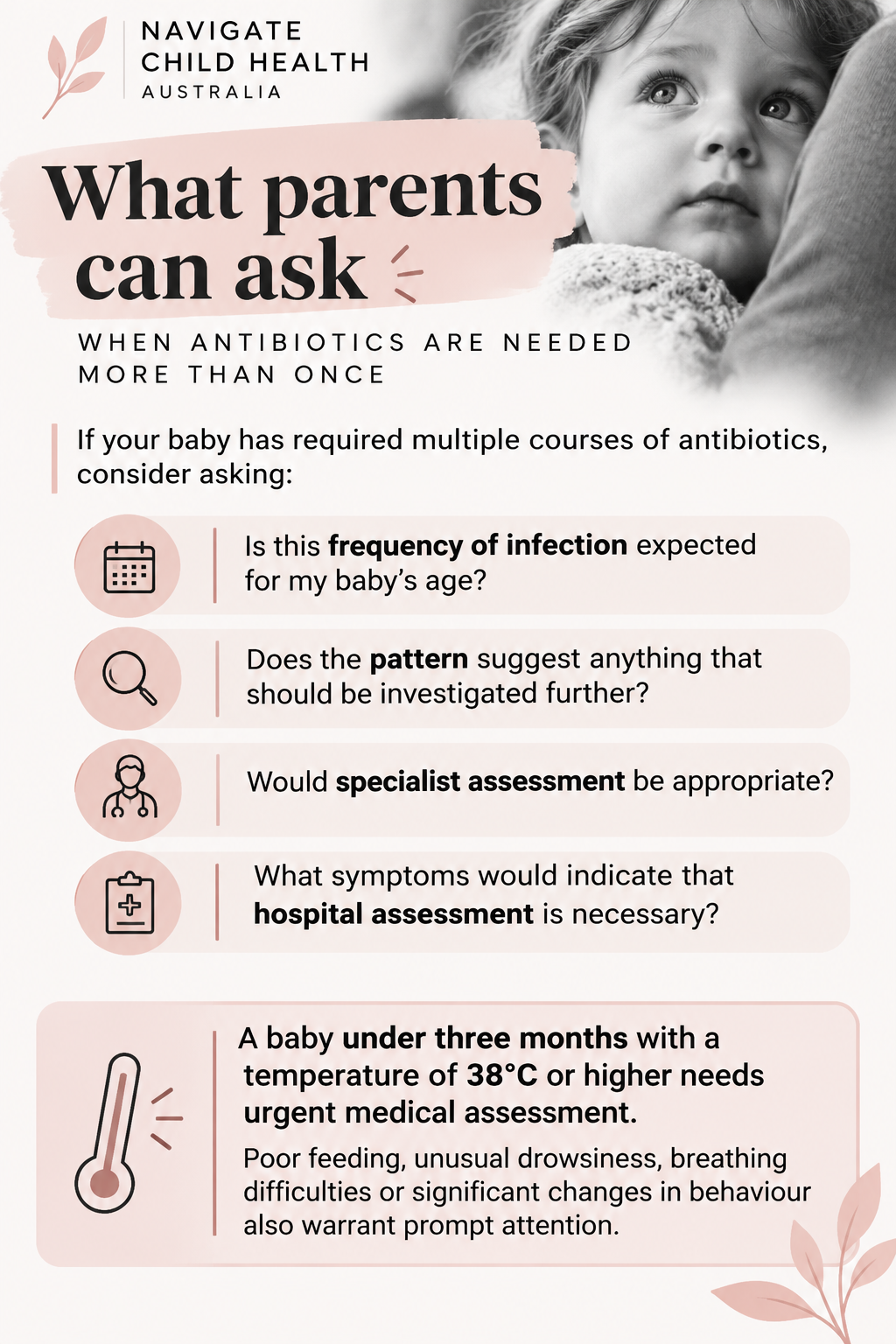
If your baby has required multiple courses of antibiotics, consider asking:
Is this frequency of infection expected for my baby's age?
Does the pattern suggest anything that should be investigated further?
Would specialist assessment be appropriate?
What symptoms would indicate that hospital assessment is necessary?
A baby under three months with a temperature of 38°C or higher needs urgent medical assessment. Poor feeding, unusual drowsiness, breathing difficulties or significant changes in behaviour also warrant prompt attention.
What if you believe your child needs antibiotics but the doctor disagrees?
This is perhaps one of the most emotionally challenging situations parents encounter. I have been here several times myself.
You know your child. You know their usual behaviour, how they respond to illness and what has happened during previous infections.
For some families, that experience extends well beyond the occasional childhood illness.
I myself have had to navigate 22 ear infections in a two-year-old in a 12 month period, despite 2 rounds of grommets, repeat surgery and ongoing specialist involvement. The frustrations I have experienced while watching my child suffer with 10 days + of fevers over 40 degree’s, multiple presentations to GP, urgent care and eventually hospital all before someone would prescribe antibiotics was absolutely excruciating not only for me and my child but our entire family.
After that many infections, parents may become highly familiar with their child's symptoms and the patterns that have previously led to treatment.
But recognising a familiar pattern doesn't necessarily mean antibiotics are required every time.
A doctor's decision may be influenced by examination findings, whether the infection appears viral or bacterial, the presence of ear discharge, previous treatments and the child's overall condition.
The challenge for parents is knowing how to communicate their concerns when the recommendation doesn't align with what they've experienced previously.
Dr Sam's perspective
We asked: When parents know their child's medical history and believe antibiotics are necessary, but the treating doctor disagrees, how should they approach the situation? When is seeking a second opinion appropriate?
Dr Sam’s answer: “Parents know their children extremely well, and their observations are an important part of the clinical assessment. However, even children with a history of recurrent bacterial infections can develop viral illnesses that don't require antibiotics.
Ear infections are a good example. Many middle ear infections resolve without antibiotics, and the decision to treat depends on the child's age, examination findings, severity and other risk factors.
In children with grommets who develop ear discharge, antibiotic ear drops may sometimes be more appropriate than oral antibiotics.
If parents disagree with the recommendation, I encourage them to ask the doctor to explain their reasoning and what changes would justify starting antibiotics.
Seeking a second opinion is entirely reasonable, particularly when a child has recurrent infections, is deteriorating or isn't improving as expected. Repeated ear infections should also prompt consideration of hearing assessment and ENT follow-up.”
How to approach the conversation
Rather than simply asking for antibiotics, it can be helpful to explain the specific reasons you're concerned.
For example:
"My child has had repeated ear infections, and these symptoms are following the same pattern as previous episodes. Can you explain what you're seeing today that suggests antibiotics aren't needed?"
You can also ask what changes would warrant reassessment, how long symptoms should reasonably continue and whether your child's history changes the treatment approach.
The goal isn't to demand a prescription.
It's to ensure that the doctor understands the full clinical history and that you understand the reasoning behind their recommendation.
You don't need to prove your child has a bacterial infection to ask for reassessment when their condition changes.
What happens when different doctors prescribe different antibiotics?
Imagine this scenario.
Your child is assessed by their GP and prescribed an antibiotic.
A few days later, their symptoms haven't improved, so you attend the emergency department. The emergency doctor recommends a different antibiotic or dosage.
Then your child's specialist reviews them and recommends something different again.
As a parent, you're left wondering:
Which doctor is right? Which antibiotic should I give? Could changing medications cause problems?
Different recommendations don't automatically mean someone has made a mistake.
Antibiotic selection can depend on the suspected bacteria, the site of infection, your child's weight, previous treatment response and whether the diagnosis has changed.
However, parents shouldn't be expected to resolve conflicting prescriptions without professional guidance.
Dr Sam's perspective
We asked: Why might a GP, emergency doctor and specialist prescribe different antibiotics, dosages or treatment durations for the same illness? How should parents navigate conflicting advice?
Dr Sams Answer: “Different recommendations don't necessarily mean one doctor is wrong. Children are often assessed at different stages of their illness, and new symptoms, examination findings or test results can change the diagnosis and treatment. For example, once bacterial culture or swab results become available, including antibiotic sensitivities, the antibiotic may need to be changed to one that is more effective against the identified bacteria.
I see this quite often in my practice. There may be several antibiotics that are effective for the same bacterial infection, and the choice of antibiotic, dose and duration of treatment can vary depending on the child's age, weight, severity of the infection, allergies and other clinical factors.
Practical considerations can also influence the choice of antibiotic. For example, if a child has difficulty taking medication, I may choose an antibiotic that only needs to be given twice a day, requires a smaller volume per dose or has a more acceptable flavour, making it easier for parents to administer and improving the likelihood that the child completes the treatment.
It's also important to recognise that prescribing errors can occasionally occur, particularly with antibiotic doses in children, which are often calculated according to weight. If parents receive significantly different doses from different doctors, they should not assume both are correct and should seek clarification before giving the medication.
When parents receive conflicting prescriptions, I recommend discussing the options with their regular GP or the doctor most familiar with their child's medical history to clarify which treatment is most appropriate. A pharmacist can also help identify discrepancies in doses or medications.
Parents should avoid combining antibiotics or switching between prescriptions without medical advice.
Ideally, one clinician should coordinate the treatment plan, particularly for children with complex medical conditions or recurrent infections.”
What parents should do
If you've received conflicting instructions, ask the treating clinician or pharmacist to clarify the current medication plan before making changes.
Useful questions include:
Why has the antibiotic or dosage changed?
Does the new prescription replace the previous one?
Should the previous medication be stopped?
Has the diagnosis changed?
What should I do if symptoms aren't improving?
Where possible, request written instructions and make sure each clinician is aware of all medications your child is taking.
Don't combine different antibiotic regimens or independently change doses to reconcile conflicting advice.
Can a viral infection turn into a bacterial infection?
This is an area where the usual public health message about antibiotics can leave parents with unanswered questions.
We're frequently reminded that antibiotics don't treat viral infections.
But a child can develop a secondary bacterial infection during or after a viral illness.
For example, a child with influenza may subsequently develop a bacterial ear infection or pneumonia.
A viral illness can also coexist with a bacterial infection.
The Royal Children's Hospital's clinical guidelines specifically caution that identifying a respiratory virus doesn't, by itself, exclude a serious bacterial infection in an unwell child.
This doesn't mean that every viral illness will develop complications, or that antibiotics should be prescribed to prevent a possible bacterial infection.
It means that the clinical picture can change.
What are the signs of a secondary bacterial infection?
There is no single symptom that reliably confirms a secondary bacterial infection at home.
However, certain changes may warrant medical reassessment:
Fever returning after the child appeared to be improving
Symptoms becoming significantly worse after initial improvement
New or increasing ear pain
Worsening cough accompanied by fever or changes in breathing
New localised pain
Persistent fever or an illness lasting longer than expected
Reduced drinking, dehydration or unusual lethargy
These symptoms do not automatically mean antibiotics are needed. They mean that your child may require another clinical assessment.
It's also important to recognise that yellow or green nasal mucus alone doesn't establish that an infection is bacterial.
Dr Sam's perspective
We asked: Parents understand that antibiotics don't treat viruses, but viral illnesses can sometimes be followed by secondary bacterial infections. What changes in a child's symptoms or illness progression should prompt reassessment? How can parents recognise when an illness may no longer be following the expected viral course?
Dr Sam’s Answer: “One of the most useful things parents can observe is the overall pattern of their child's illness.
Many viral infections cause fever and significant symptoms for several days before gradually improving. A secondary bacterial infection becomes more concerning when a child initially improves and then deteriorates again, particularly with a return of fever or new symptoms.
Two common bacterial infections that can develop following a viral illness in children are middle ear infections (otitis media) and pneumonia.
With an ear infection, parents may notice new or worsening ear pain, increased irritability, disturbed sleep or discharge from the ear. Younger children may be particularly unsettled and unable to communicate where the pain is coming from.
With pneumonia, concerning symptoms include a worsening cough, rapid or difficult breathing, chest pain, persistent or returning fever, or a child who appears increasingly unwell.
However, these symptoms don't necessarily mean a bacterial infection is present. Similarly, green or yellow nasal discharge alone doesn't mean antibiotics are required.
The child's overall appearance and behaviour are often more informative than the temperature alone.
Parents should seek medical reassessment, preferably on the same day, if their child develops new or worsening symptoms, particularly a return of fever after initial improvement, significant ear pain, ear discharge, faster breathing than usual or a worsening cough accompanied by fever. A fever lasting five days or longer also warrants medical review.
At home, parents should pay particular attention to their child's breathing, fluid intake, urine output and level of alertness. A child who is drinking reasonably well, breathing comfortably and becoming more active between episodes of fever is generally more reassuring than one who remains lethargic or is progressively deteriorating.
Parents should seek immediate emergency care if their child has severe difficulty breathing, blue or grey lips, is difficult to wake, or appears seriously unwell. They should not wait for a scheduled appointment if their child's condition is rapidly deteriorating.”
One question worth asking before leaving the doctor
"What changes should I look for that would tell me this illness isn't progressing as expected?"
This is often more useful than being told simply to return if your child gets worse.
A clear plan should explain the expected course of the illness, when improvement should occur and what changes should prompt another assessment.
What if the doctor prescribes antibiotics but you don't think they're necessary?
Disagreement about antibiotics can happen in both directions.
Sometimes parents are concerned that antibiotics are being prescribed unnecessarily.
Perhaps their child appears to be improving. Perhaps they've experienced side effects from previous antibiotics. Or perhaps another doctor previously suggested the illness was viral.
It's reasonable to want to understand why antibiotics have been recommended.
Some bacterial infections require prompt treatment, while others may be suitable for monitoring or a delayed prescription, depending on the diagnosis and the child's circumstances.
The important thing is to understand whether waiting is a medically appropriate option for your child.
Dr Sam's perspective
We asked: What should parents do when a doctor recommends antibiotics but they aren't convinced they're necessary? What questions should they ask, and when might monitoring without immediate antibiotics be appropriate?
Dr Sam’s Answer: “I think it's entirely appropriate for parents to ask questions before starting antibiotics.
Some useful questions include:
What bacterial infection are we treating, and how certain are we of the diagnosis?
What benefit should we expect from antibiotics?
What are the possible side effects?
Is it safe to monitor my child without antibiotics initially?
What symptoms would mean we need to start treatment or seek reassessment?
It's important for parents to understand that most common childhood illnesses involving a runny nose, cough, flu-like symptoms or sore throat are caused by viruses and don't usually require antibiotics. Most sore throats are viral, although in some cases a throat swab can be taken before starting antibiotics to check for a bacterial infection.
Antibiotics are extremely valuable when genuinely needed, but unnecessary treatment can cause side effects, including diarrhoea and allergic reactions, contribute to antibiotic resistance and disrupt the gut microbiome.
For some conditions, such as uncomplicated middle ear infections, careful observation with a clear follow-up plan may be appropriate. For other infections, delaying treatment can be dangerous.
Ultimately, the goal isn't to avoid antibiotics or prescribe them routinely. It's to use antibiotics when the expected benefits outweigh the risks, based on the individual child's clinical circumstances.
Five questions every parent can ask about antibiotics
Whether your doctor recommends antibiotics or not, these questions can help you leave the appointment with a clearer understanding of the plan.
1. What is the most likely cause of my child's illness?
Understanding the suspected diagnosis helps explain why antibiotics may or may not be useful.
2. Does my child's medical history change how this infection should be managed?
This is particularly important for children with recurrent infections, previous complications or complex medical histories.
3. What improvement should I expect, and when?
Ask what recovery should look like over the next 24–72 hours and whether the expected timeline differs for your child's illness.
4. What changes should prompt another medical review?
Try to establish specific symptoms or changes rather than relying on a general instruction to return if things get worse.
5. What should I do if I'm still concerned or the treatment isn't working?
Ask whether to return to the GP, contact a specialist, seek urgent care or attend an emergency department.
When should parents seek urgent medical assessment?
Regardless of whether an illness is thought to be viral or bacterial, some symptoms require urgent attention.
Should you be concerned about your child - seek medical advise from a qualified medical professional.
You can see our guide here: “Should I Take My Child to Hospital, Urgent Care, GP or Virtual ED? (Australia Guide)”
Final thoughts: advocating for your child isn't about demanding antibiotics
Parents and doctors bring different perspectives to a consultation.
Doctors bring clinical expertise, examination findings and knowledge of evidence-based treatment.
Parents bring detailed knowledge of their child's usual behaviour, medical history and how their symptoms have changed over time.
Both perspectives matter.
Sometimes advocating for your child means accepting that antibiotics aren't necessary.
Sometimes it means asking more questions, seeking clarification or requesting another assessment.
And sometimes it means recognising that an illness has changed and the original treatment plan may need reconsideration.
The goal isn't to get the antibiotic prescription you expected. It's to understand the decision, recognise when things aren't progressing as expected and know what to do next.
Related Articles:
Child Still Sick After Antibiotics? What to Do If They’re Not Getting Better
My Child Is Getting Worse but We Already Saw a GP: What To Do Next (Australia Guide)
Waiting for Grommet Surgery in Australia: What Parents Can Do While on the Waitlist
Worried About Your Child’s Breathing? When and Where to Seek Help in Australia
About our expert contributor: Dr Sam, Telebaby Australia

Dr Sam is a paediatrician providing telehealth consultations for newborns, babies and older children through Telebaby Australia.
His contribution to this article explores common questions parents face when navigating antibiotic decisions, recurrent infections and differing medical opinions.
Visit Telebaby Australia to learn more about its paediatric telehealth services.
Navigate Child Health Australia thanks Dr Sam for his valuable insights and contributions to this article. Without him, we could not have brought you this information. Thank you again Dr Samuel Heitner - Telebaby Australia
Australian medical references
Healthdirect Australia — What is the difference between bacterial and viral infections?
Royal Children's Hospital Melbourne — Febrile child clinical practice guideline
Medical disclaimer: This article provides general health information and healthcare navigation guidance only. It does not replace individual medical advice, diagnosis or treatment from a qualified healthcare professional. Antibiotic decisions must be based on each child's clinical circumstances. Seek urgent medical assessment if your child is seriously unwell.
Navigate Child Health Australia helps Australian parents understand their healthcare options, prepare for appointments and navigate medical services for their children.
www.navigatechildhealthaustralia.com
